


PROFESSIONAL TRAINING · RECREATIONAL DIVING · CONSERVATION
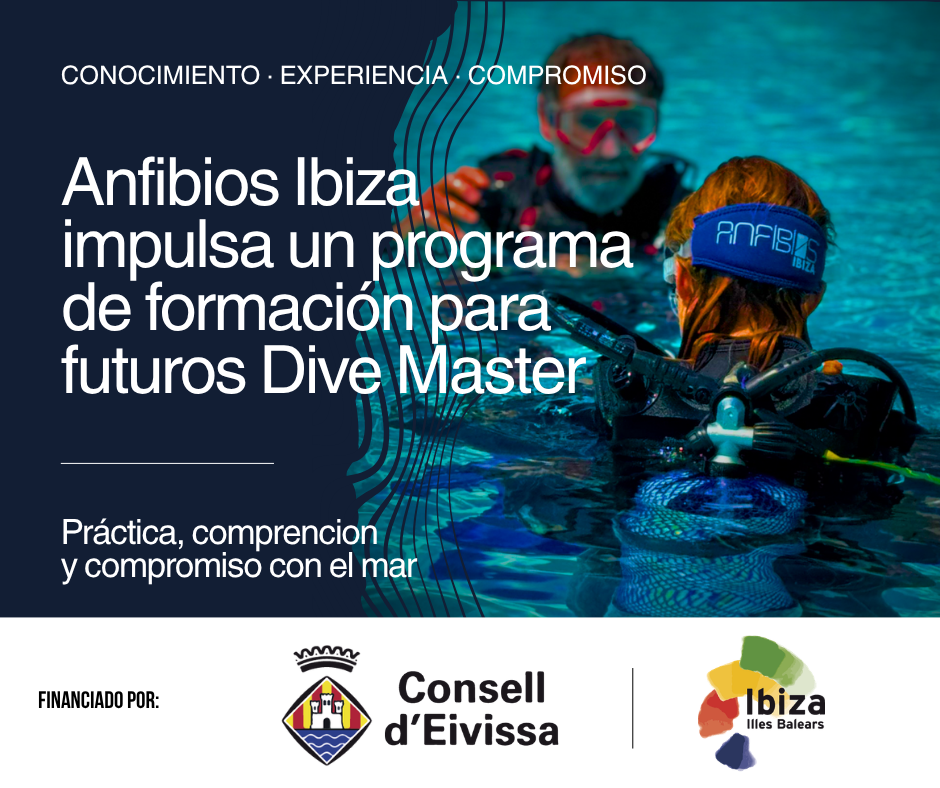
Training Divemasters to create true marine professionals
An Anfibios Ibiza program based on practice, understanding, and commitment.
BEYOND CERTIFICATION: Training to lead, care, communicate, and set an example.
I am proud to share one of the projects we are currently working on at the Anfibios Ibiza diving center, funded by the Ibiza Island Council’s Department of Tourism: a training program that guides participants through the recreational diving journey, from Open Water Diver to Divemaster certification.
However, our goal is not only to help them obtain certification. We want to contribute to training competent, responsible professionals capable of becoming true ambassadors for the sea.
The Divemaster certification represents the first major step in a recreational diving career. Those who reach this level begin to assume responsibilities related to organizing activities, supervising other divers, managing groups, and ensuring safety and environmental protection. Therefore, we believe their preparation should go beyond simply learning a series of procedures or passing certain tests.
Beyond Minimum Standards
Training is based on the programs and standards established by SSI, and also incorporates workshops, exercises, and supplementary practice designed by our team.
These additional activities do not replace or modify the official training standards. They expand and reinforce them with a very specific purpose: to ensure that participants not only know how to perform a skill, but also understand why it is performed, when it should be applied, and how they will need to explain or demonstrate it in the future.
The program encompasses the entire training path necessary to progress from Open Water Diver to Divemaster. Throughout this journey, participants will develop theoretical knowledge, aquatic skills, buoyancy control, planning and safety, navigation, rescue, leadership, activity organization, and assistance to other divers.
In addition, we incorporate training designed to strengthen autonomy, observation skills, communication, and decision-making abilities. The goal is that, should they later decide to pursue a career as instructors, they will reach that stage with a foundation of knowledge and practical experience that exceeds the minimum requirements.
We are not simply aiming to certify divemasters. We aspire to train individuals prepared to responsibly assume the role of diving professionals.
A new educational reality
This project is also born from a reflection accumulated over many years of teaching.
The new generations have grown up in an environment marked by overinformation, immediacy, social networks and the permanent consumption of audiovisual content. It is increasingly difficult to maintain concentration in the face of extensive materials and, sometimes, reading content does not necessarily mean that you have understood it.
It is not just a personal perception. The PISA 2022 results indicate that 24% of 15-year-old Spanish students did not reach the basic level of reading proficiency. In addition, researcher Gloria Mark, from the University of California, Irvine, has documented that the average time a person remains focused on the same screen before changing their attention went from approximately two and a half minutes in 2004 to about 47 seconds in her most recent measurements.
This reality does not mean that young people cannot learn or that they lack interest. It means that trainers must review how we transmit knowledge, check if it has really been understood and combine different forms of learning.
Continuing to use exclusively the same old methods may be insufficient. The answer is not to oversimplify content either, but to find new ways to make it understandable, attractive and applicable.
Diving as an Active Learning Environment
Diving offers an extraordinary setting for this type of learning.
It is an activity that demands discipline, self-control, responsibility, communication, and genuine teamwork. A diver must learn to recognize their own capabilities, control their emotions, anticipate certain situations, and collaborate with their buddy, because one of the fundamental principles of our activity is that you never dive alone.
It is also a magnificent laboratory for applied physics. Underwater, concepts such as pressure, buoyancy, density, gas compression, Boyle’s Law, and Archimedes’ Principle cease to be abstract formulas written on a blackboard. Students can observe them, experience them, and feel their effects directly on their own bodies and equipment.
When a student understands why the volume of air in their buoyancy compensator changes during an ascent, why their buoyancy varies, or why they must equalize their air spaces, the theory takes on real meaning. It’s no longer just about memorizing an answer to pass an exam: it incorporates knowledge that can be applied to dive more safely, comfortably, and with greater respect for the environment.
For this reason, this program also functions as an experiential classroom. Participants collaborate with their instructors in developing visual materials, demonstrations, and small experiments that facilitate understanding of the physical principles of diving.
This process has a dual purpose: it helps consolidate their own knowledge and, at the same time, teaches them to create resources they can use when they need to guide, inform, or train future students.
To teach effectively, it’s not enough to know how to do something. You have to understand it, be able to explain it, and be able to adapt it to each person’s needs.
Professionals and Ambassadors of the Sea
The training of a Divemaster or a future instructor cannot be separated from marine conservation.
Diving professionals occupy a privileged position: they accompany others in their discovery of the underwater world and can directly influence their behavior. Every explanation before a dive, every buoyancy adjustment, and every decision made underwater can contribute to protecting—or damaging—the environment we visit.
“People protect what they love.”
JACQUES-YVES COUSTEAU
But to truly love the sea, we must first get to know it, observe it, and understand its fragility. That is why we want our future divemasters to actively participate in awareness and conservation efforts, learn to share best practices, and understand that their responsibility does not end when the dive is over.
A good professional not only guides a group underwater, but also educates through their behavior and acts as an example of respect for the marine environment.
Technology as an Ally
We must also recognize that we live in a completely different era than the one in which many of us trained as instructors.
New generations connect, learn, and stay informed through a digital ecosystem where social media has an almost constant presence. Ignoring this reality won’t make it disappear. Our challenge is to learn to use these tools responsibly.
Therefore, another area of the program is dedicated to communication and content creation. Students participate in the creation of photographs, videos, educational materials, and publications to explain diving concepts and disseminate messages related to marine safety and conservation.
Social media can foster superficiality, but it can also become an extraordinary tool for educating, inspiring, and bringing the ocean closer to people who are still unfamiliar with it. The difference lies in the content we choose to create and the purpose for which we share it.

A project we will be showcasing
This entire process is being documented. Over the next few months, we will be sharing details about the program, the workshops held, the experiments conducted, and the progress of its participants.
The results will be presented in October, coinciding with the program’s completion and the celebration of SCUBAWEEK 2026 – Ibiza Ocean Culture Week.
This project represents our vision for the future of scuba diving instruction: rigorous, practical, visual, and participatory training; adapted to the current reality, but without compromising on rigor, safety, or depth of knowledge.
Because achieving Divemaster level shouldn’t just mean obtaining a certification. It should mean being prepared to lead, care, communicate, and set an example.
Ultimately, becoming a true professional and ambassador for the sea.
Sources consulted
- OECD. PISA 2022 Results – Country Note: Spain. In Spain, 76% of students reached at least level 2 of reading comprehension; 24% fell below that level.
- University of California, Irvine. Gloria Mark’s research on attention and digital distractions.
ANFIBIOS IBIZA •